Perfume Bottle Sizes & Capacities: A Practical Cheat Sheet (1-100ml)
Nov 16,2026
From 2ml samples to 100ml full size — capacity shapes both the price point and the customer's first impression.
Perfume bottles run from 2 ml sample vials to 100 ml full-size flacons, and the "right" size is rarely a single answer. It depends on what the customer will do with it — try it, travel with it, gift it, or wear it daily — and on what the brand wants each format to achieve. This cheat sheet maps every common capacity to its fluid-ounce equivalent, spray count, best use, and the travel and packaging rules that constrain it.
At a glance
≈1,000sprays in a 100ml bottle at 0.1 ml/spray
100 mlcarry-on liquid limit (3.4 fl oz) per container
64.7%of the perfume packaging market is under 100 ml
Why Perfume Bottle Size Is a Business Decision
Capacity is not just a container dimension — it sets your entry price, shipping weight, shelf presence and reorder cycle. The global perfume packaging market was valued at USD 3.72 billion in 2025 and is projected to reach USD 6.89 billion by 2034 (a 7.18% CAGR), with glass holding 53.32% of the material share, according to Fortune Business Insights. Within that market, the under-100 ml segment accounts for roughly 64.69% — small and mid formats win on discoverability, travel convenience and lower entry price.
Two facts worth internalising before you brief a supplier:
Cost per ml is not linear. The glass, pump, collar, cap and carton cost roughly the same whether they wrap 30 ml or 50 ml, so small bottles are premium-priced for accessibility — not for economy.
One millilitre ≈ ten sprays. At the industry-standard fine-fragrance dose of 0.1 ml per actuation, a 50 ml bottle delivers about 500 sprays — roughly 125 days at four sprays a day.
The Complete Size Cheat Sheet (2–100 ml)
Here is the full ladder of commercial capacities, from dab-on sample to jumbo value size. Spray counts use the 0.1 ml fine-fragrance dose as a baseline.
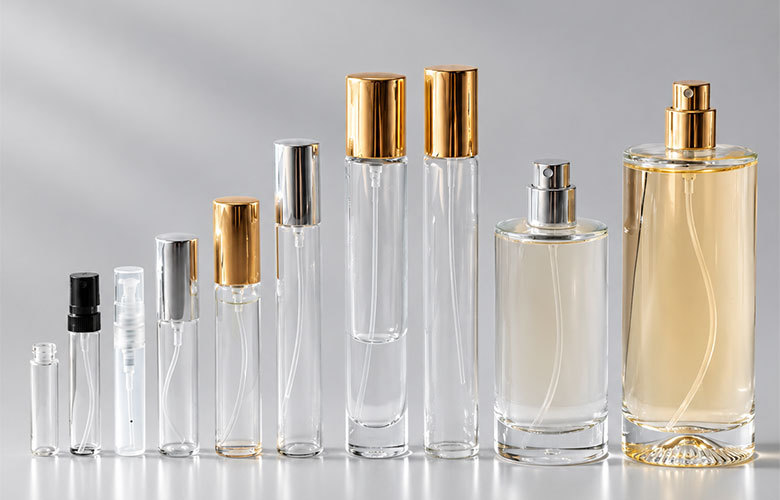
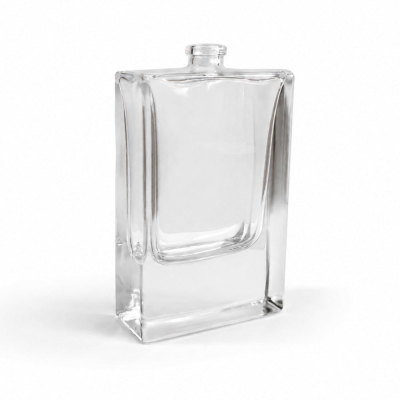
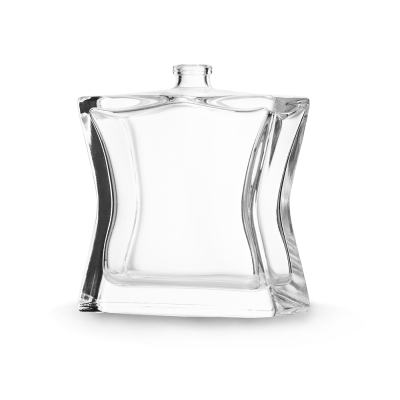
Different capacities and neck finish profiles in one GPBottles production family — matching sizes, not mixing components, keeps a range cohesive.
Capacity
US fl oz
Approx. sprays*
Typical use
2 ml
0.07 oz
~20
Discovery vial, dab-on, magazine insert
5 ml
0.17 oz
~50
Sample spray, gift-with-purchase
10 ml
0.34 oz
~100
Travel atomizer, pocket spray
15 ml
0.51 oz
~150
Large travel / purse spray, discovery set
30 ml
1.0 oz
~300
Entry full size, gifting, market test
50 ml
1.7 oz
~500
Core retail, everyday wear (global bestseller)
75 ml
2.5 oz
~750
Generous mid-size, premium lines
100 ml
3.4 oz
~1,000
Full size, best value, loyal users
*Spray counts are theoretical: bottle volume ÷ dose per stroke. They do not deduct priming strokes, evaporation, leakage or the product that never clears the dip tube.
Quick ml ↔ fl oz Conversion Reference
One US fluid ounce equals 29.5735 ml. Retailers round this for labelling, which is why a "1 oz" bottle holds 30 ml and a "3.4 oz" bottle holds 100 ml — a practical dual declaration, not a statement that the two figures are identical to every decimal.
Millilitres (ml)
US fl oz (approx.)
Common label
5 ml
0.17 oz
Sample / mini
10 ml
0.34 oz
Travel atomizer
15 ml
0.51 oz
Half-ounce travel
30 ml
1.0 oz
1 fl oz
50 ml
1.7 oz
1.7 fl oz
75 ml
2.5 oz
2.5 fl oz
100 ml
3.4 oz
3.4 fl oz
125 ml
4.2 oz
Extended size
200 ml
6.8 oz
Jumbo / refill
How Many Sprays Are Actually in a Bottle?
Spray count is not fixed by capacity — it depends on the pump's dose, or "actuation volume". Fine-fragrance pumps are typically specified between 0.06 ml and 0.16 ml per stroke, with 0.10 ml the most common for Eau de Parfum and Eau de Toilette. The same 100 ml bottle can therefore yield anywhere from about 625 to 1,667 sprays depending on the pump you choose.
Size
0.07 ml/stroke
0.10 ml/stroke
0.13 ml/stroke
30 ml
429
300
231
50 ml
714
500
385
75 ml
1,071
750
577
100 ml
1,429
1,000
769
A finer mist at a lower dose usually reads as more luxurious and makes a small bottle last longer. A wetter, higher-dose pump is better suited to body mists than to concentrated fragrance.
Travel Rules: The 100 ml Carry-On Limit
If you sell a travel or discovery format, the number that matters most is 100 ml (3.4 fl oz). Under the TSA's liquids rule — commonly called the 3-1-1 rule — each carry-on container must be 3.4 oz (100 ml) or less, all liquids must fit in one quart-sized clear zip-top bag, and there is one bag per passenger.
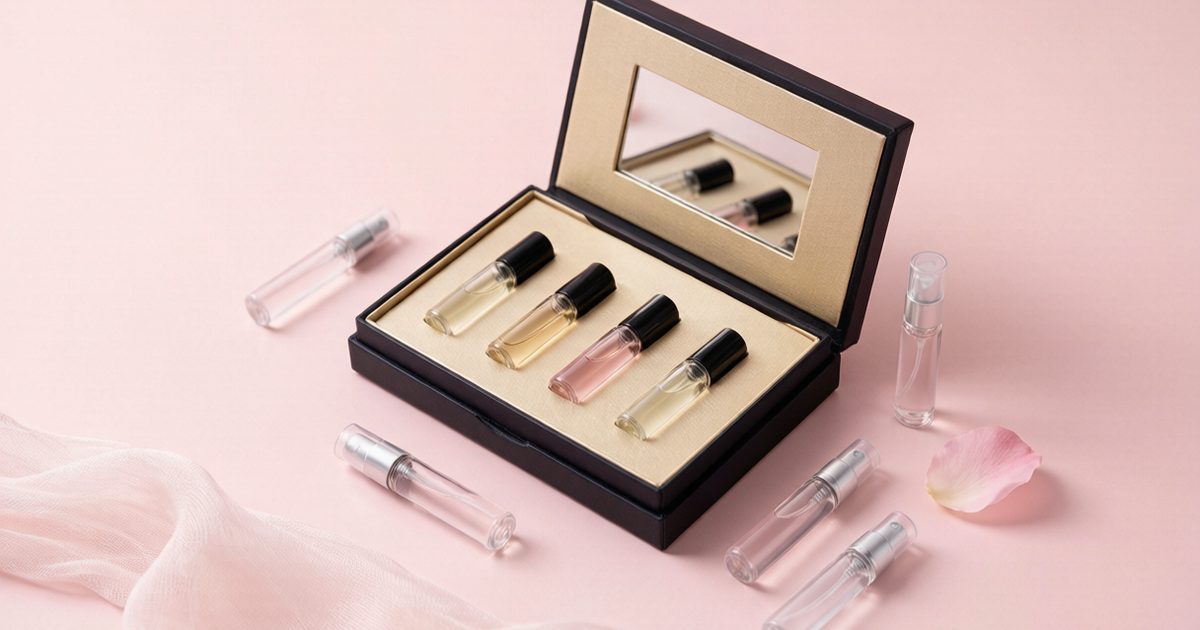
Sample and travel-size bottles in GPBottles' range — formats designed to clear the carry-on limit without a second thought.
100 ml is the practical ceiling for travel retail and duty-free; anything larger must be checked.
10–15 ml minis are the sweet spot for discovery sets, event favours and "buy 50 ml, get 10 ml" promotions.
Duty-free liquids over 100 ml may travel in a secure, tamper-evident bag with the receipt when purchased internationally on an inbound US itinerary — but packing them checked is still the safer default.
How Size Affects the Neck, Pump and Cap
Capacity does not dictate the neck — the neck is chosen for the bottle design and the closure system. The standard for fine fragrance is the FEA crimp neck, named after the Fédération Européenne des Aérosols; the European standard EN 14854 covers glass finishes of roughly 11–20 mm (FEA 11 through FEA 20), with FEA 15 the most common for spray fragrance.
A cap, collar and pump specified together as one assembly — the neck finish locks all three into place.
Finish
Type
Refillable
Typical use
FEA 15
15 mm crimp
No
Fine fragrance spray, luxury feel
15/415
15 mm screw
Yes
Travel, refills, small-to-mid formats
18/415
18 mm screw
Yes
Larger formats, heavier closures
Two practical rules follow from this:
Keep one neck across the range. If your 30, 50 and 100 ml all share an FEA 15 neck, the same cap and collar tooling serves the whole line — fewer components to stock and less chance of mismatch.
Match the dip tube to each bottle's internal height. A tube cut too short strands product at the bottom; one cut too long bends against the base and throttles the spray. This is the specification most often missed when bottles and pumps come from different suppliers.
Size vs. Concentration: Two Different Things
A common confusion: bottle size and fragrance concentration are independent. A 30 ml bottle can hold a 20% extrait, and a 100 ml bottle can hold a 5% eau de toilette. The label (EDC, EDT, EDP, extrait) describes the percentage of fragrance oil, not the volume. Per IFRA guidance these terms are industry descriptors, not hard legal cut-offs, and the ranges overlap.
Label
Typical oil concentration
Typical wear
Eau de Cologne (EDC)
3–8%
2–3 hours, fresh and brief
Eau de Toilette (EDT)
5–15%
3–5 hours, daytime
Eau de Parfum (EDP)
10–20%
6–8 hours, everyday
Parfum / Extrait
15–40%
8–12+ hours, intimate
For a brand planning its range, the practical implication is to pair concentration with capacity deliberately: a high-concentration extrait suits a smaller, more luxurious bottle, while a light EDT suits a larger, spray-happy format.
Choosing the Right Sizes for Your Fragrance Line
More sizes do not equal more sales — every extra SKU means more glass to track, print and pack. A simple, intentional ladder almost always outperforms a sprawling one.
1
Lead with 50 ml. It is the global bestseller and the safest hero size: premium enough to feel substantial, affordable enough to convert a first-time buyer.
2
Anchor value with 100 ml. Position it as the "best price per ml" to lift average order value for customers who already love the scent.
3
Open the door with samples. A 2–5 ml sample or a 10–15 ml travel spray lowers the blind-buy risk and feeds the funnel toward the 50 ml.
GPBottles Size Availability
As a perfume bottle manufacturer, GPBottles supplies the full ladder in one family: sample and travel sizes from about 2 ml to 15 ml, plus 30 ml, 50 ml and 100 ml full sizes — with FEA crimp necks and screw options, matched caps, collars and pumps, and low-MOQ runs for niche and indie brands.
GPBottles' production line — capacity families are moulded, filled and finished under one roof to keep specs consistent across sizes.
See GPBottles' sample, full-size and travel categories to match sizes to your line, or reach out for a capacity plan built around your price point and distribution channel.
Frequently Asked Questions
What are the standard perfume bottle sizes?
The common commercial ladder is 2 ml, 5 ml, 10 ml, 15 ml, 30 ml, 50 ml, 75 ml and 100 ml. In US retail the three core sizes are 30 ml (1 oz), 50 ml (1.7 oz) and 100 ml (3.4 oz).
Can I take a 100 ml perfume in my carry-on?
Yes. Containers of 100 ml (3.4 oz) or less are allowed in carry-on, provided all liquids fit in one quart-sized clear bag. Anything over 100 ml per container must go in checked baggage.
How many sprays are in a 50 ml bottle?
About 500 sprays at the standard 0.1 ml per actuation. The exact number depends on the pump's dose, which typically ranges from 0.06 ml to 0.16 ml per stroke.
Does a bigger bottle mean a stronger fragrance?
No. Bottle size is volume; strength is set by concentration (EDT vs EDP vs extrait). A 30 ml extrait can be far more intense than a 100 ml eau de toilette.
What neck finish does a perfume sprayer use?
Fine fragrance typically uses an FEA 15 crimp neck (per EN 14854), with screw alternatives like 15/415 and 18/415 for refillable and travel formats.
Sources & standards: TSA "Liquids, Aerosols, and Gels Rule" (tsa.gov) · Fortune Business Insights, perfume packaging market · FEA / EN 14854 glass neck finishes · IFRA guidance on fragrance concentration terms. Spray counts are mathematical estimates and should be verified against your chosen pump dose and filled pack.
Build your custom perfume bottle with GPBottles
Low-MOQ runs, REACH-compliant glass and full decoration — made for niche and indie fragrance brands.