REACH & FDA Compliance for Perfume Packaging: What Niche Brands Must Know
Oct 19,2026
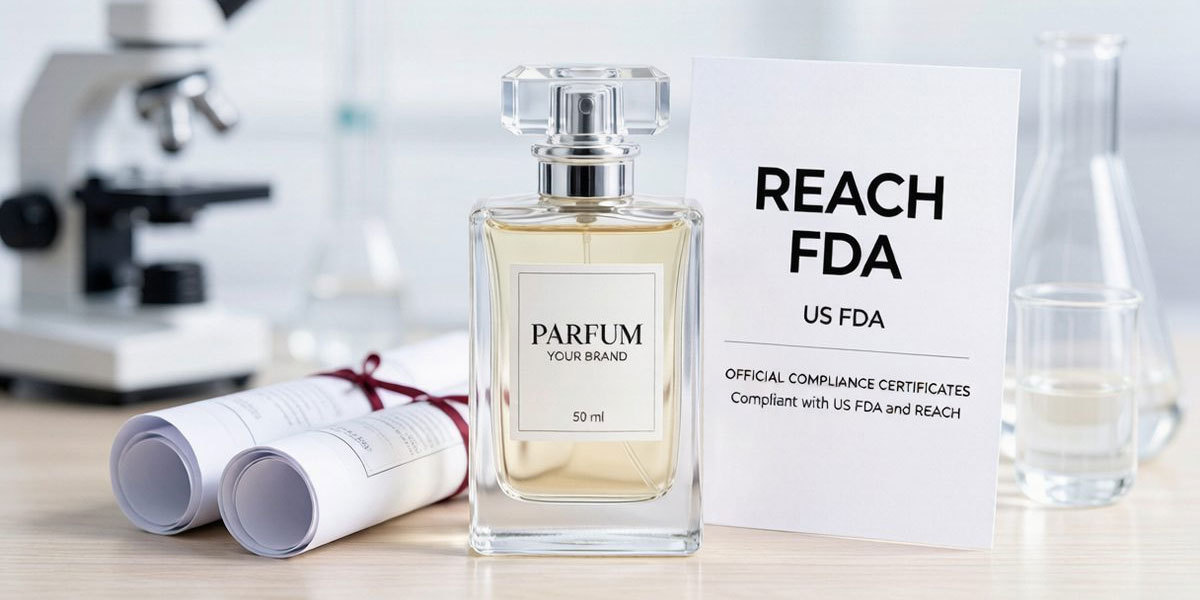
Compliant packaging is what turns a custom bottle into a market-ready product in the EU and US.
Perfume packaging compliance is not a formality at the end of sourcing — it is the difference between a shipment that clears customs and one that is held, returned, or rejected by a retail buyer. For niche and indie fragrance brands shipping into the EU and the US, "compliant" means two things: your glass, closures, and decoration stay inside EU chemical restrictions under REACH, and your materials meet US contact-material expectations under the FDA. This guide explains both, the documents to request, and where the real compliance risk actually sits.
The short version: glass is usually clean. The compliance risk lives in the decoration layer — ceramic inks, metallic pigments, surface coatings, adhesives, and the metal caps, collars, and pumps attached to the bottle.
REACH for Perfume Bottles: Annex XVII and the SVHC Candidate List
REACH — Regulation (EC) No 1907/2006 — treats a perfume bottle as an article rather than a chemical substance, which gives brands two parallel duties. The first is the SVHC Candidate List: substances of very high concern (carcinogens, mutagens, reprotoxins, and persistent pollutants) that trigger a communication duty when present above 0.1% by weight in any single homogeneous material. The second is Annex XVII: roughly 70 restricted substance groups with hard concentration limits that must not be exceeded at all.
A point of clarity: there is no official "REACH 233" list. The numbered entries inside Annex XVII — for example entry 23 (cadmium) and entry 63 (lead) — are what many brands are loosely referring to. Getting the terminology right matters, because a certificate that only names "REACH" without stating which annex, entry, and list version it was checked against is a red flag during an audit.
The 0.1% SVHC Rule and Where the Risk Hides
The 0.1% threshold applies per homogeneous material, not per bottle. A bottle made of clear glass, a colored collar, a zamac cap, and a sprayed coating is four separate materials, and each one is assessed independently. When an SVHC is present above 0.1%, the supplier must communicate under Article 33, and importers above one tonne per year must also submit data to the SCIP database.
For a standard soda-lime glass bottle, the glass substrate itself rarely triggers anything. The exposure concentrates in the decoration and metal hardware: ceramic screen-printing inks and metallic pigments that can carry lead or cadmium, zinc-alloy (zamac) caps and collars with nickel release, and plastic seals or plungers that may contain phthalates or PAHs.
Decoration, caps, and collars — not the glass — are where REACH limits are most often exceeded.
Restricted substances to watch in perfume packaging (Annex XVII highlights)
Substance / group
Where it hides
Typical limit
Phthalates (DEHP, DBP, BBP, DIBP)
Plastic collars, spray-through caps, seals
≤0.1% combined
Lead
Decorated glass, coatings, metal caps
≤0.05% (entry 63) + migration caps
Cadmium
Pigments, metal caps, zamac alloys
≤0.01% (entry 23)
Nickel release
Zamac / zinc-alloy collars
≤0.5 µg/cm²/week (skin contact)
PAHs
Rubber / plastic seals and plungers
Category-specific limits
AZO dyes
Colored collars, printed coatings
<30 ppm
FDA: There Is No "FDA-Approved" Bottle
In the US, the FDA does not pre-approve cosmetic packaging and issues no "FDA certificate" for bottles — any supplier advertising one is overstating. Under the FD&C Act, 21 CFR Parts 700–740, and the 2022 MoCRA expansion, the registration and listing obligations fall on the brand or importer that fills the bottle, not on the glass factory. What the FDA expects from packaging itself is narrower and entirely about safety: the material must be suitable and inert in contact with the formula, backed by migration and leach data, and produced under good manufacturing practice.
Standard soda-lime glass is generally recognized as safe for fragrance contact, which is why the practical questions again land on the decoration and any internal coating. Brands selling into the US should also keep two adjacent rules in view: California Proposition 65 warning labels for listed chemicals, and child-resistant packaging (16 CFR §1700) for bottles of 200 mL or less.
Inert soda-lime glass keeps the FDA picture simple; safe decoration keeps it compliant.
The Documents to Request from Your Supplier
Ask for these per shipment — not once at the start of the relationship — and confirm each one references your SKU and the list version it was checked against.
REACH SVHC declaration
Article 33 communication confirming no SVHC above 0.1% per material.
Annex XVII restriction report
Lab results for heavy metals, phthalates, and relevant entries.
REACH Declaration of Compliance
A dated DoC covering substrate plus decoration and hardware.
FDA material statement
Confirms suitability and inertness for fragrance contact.
Migration / leach test
Heavy-metal migration data for the finished, decorated article.
Batch traceability + GMP
Lot numbers tied to materials, decoration, and QC records.
REACH vs FDA at a Glance
How the two regimes compare for perfume packaging
Dimension
EU — REACH
US — FDA
Governing law
Regulation (EC) 1907/2006
FD&C Act, 21 CFR 700–740, MoCRA
Approval model
No pre-approval; restriction + notification
No pre-approval; no packaging "certificate"
Key threshold
0.1% SVHC per homogeneous material
No toxic migration into formula
Core documents
SVHC declaration, Annex XVII report, DoC
Material statement, migration data, GMP
Risk area
Decoration, metal caps, plastic seals
Decoration, internal coatings
Update cadence
SVHC list updated ~twice a year
Facility registration biennial (MoCRA)
A Six-Step Compliance Workflow
1
Screen materials
Map every homogeneous material — glass, coating, ink, adhesive, cap, seal — against the live ECHA Candidate List.
2
Request SVHC declarations
Ask for Article 33 declarations per material. An SVHC declaration is not the same as a REACH registration number.
3
Verify Annex XVII tests
Confirm restriction-limit results for heavy metals, phthalates, and other relevant entries.
4
Check Annex XIV
Confirm no authorization-only substance is used; rare in perfume packaging but worth excluding.
5
Compile a compliance file
Bundle declarations, test reports, and a dated review log into a single CoC file.
6
Review twice a year
ECHA updates the Candidate List roughly every six months; re-screen against each new delta.
Mistakes That Delay Shipments
Confusing "REACH registered" with "REACH compliant" — registration does not tell you SVHC concentration.
Accepting a declaration that names no list version and no SKU reference.
Testing only the glass substrate while ignoring the decoration and metal hardware.
Using a one-time certificate for every later shipment of a changed design.
Overlooking Prop 65 and child-resistant packaging rules for the US.
Documentation that references your exact SKU is what customs and retail buyers actually ask for.
Frequently Asked Questions
Does the FDA certify perfume bottles?
No. The FDA does not pre-approve or certify cosmetic packaging. Compliance is demonstrated through material suitability, migration data, and GMP — not a certificate.
Is soda-lime glass automatically REACH-compliant?
The glass substrate is usually clean, but the finished article also includes coatings, inks, adhesives, and metal hardware. Compliance must cover the whole decorated product, not just the glass.
What is the difference between SVHC and Annex XVII?
The SVHC Candidate List triggers a communication duty above 0.1% per material. Annex XVII sets hard concentration limits that must not be exceeded. They are separate obligations.
How often should compliance documents be refreshed?
At minimum per shipment, and again whenever the design, decoration, or supplier changes. The EU SVHC list is also updated roughly twice a year, so review on that cadence.
Compliance is a documentation discipline as much as a material one. Get the correct terms, request SKU-specific documents per shipment, and review against each SVHC update — and your custom perfume packaging will clear the EU and US doors without surprises. Ask GPBottles about compliance documents for your next order